Politics · Crown
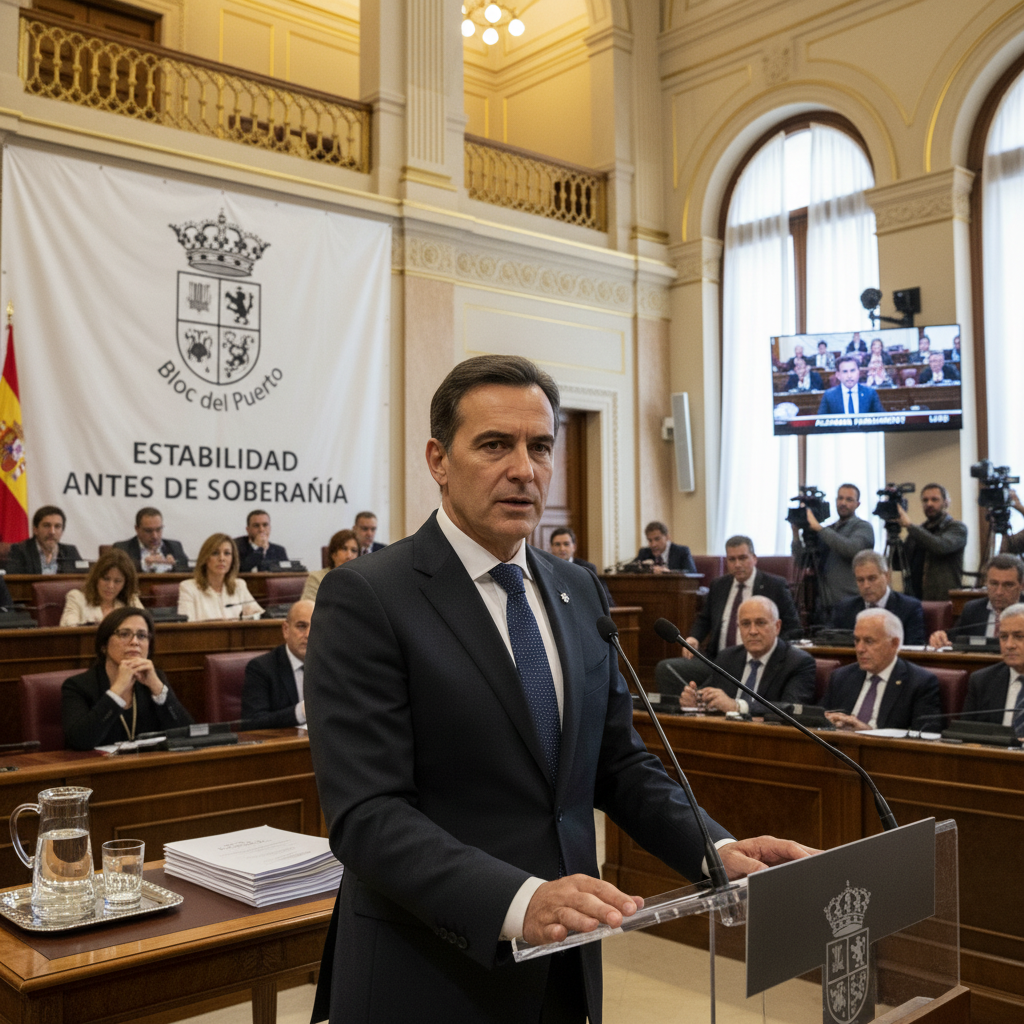
Cordoba: stability before sovereignty as Crown weighs the cordon
The patriarch of the Bloc del Puerto frames the cordon, the pumps, and the ambassador's visit as a single question of nerve, to be answered without theatre.
By V. Aldama·3 min read
ALMARIA VELLA — In a statement issued to this newspaper on the eve of an emergency cabinet sub-committee, Don Alejandro Cordoba set the week's terms with the plainness of a man who has long ceased to be surprised by storms. "There are moments," he wrote, "when a nation must choose between the theatre of sovereignty and the substance of it." The substance, in his telling, is the pump, the pier, and the payroll; the theatre, one gathers, is the rest.
The statement, which this Herald prints in fuller compass on page three, arrived as the Royal Coast Guard completed the transfer to port authorities of some forty foreign activists taken from a civilian vessel south of Cordoba Bay. The cordon at issue was laid down not by Almaria but by a regional power whose ambassador spent Tuesday afternoon in the Foreign Ministry's private drawing room. Cardenal Marín, receiving him, is understood to have spoken with that particular courtesy which in Almarian diplomacy has always been the preface to firmness.
Crown sources confirm that His Majesty King Juan was briefed twice in the course of the day — once before the ambassador's arrival, once after — and that the phrase "territorial approaches" was, at the King's own insistence, retained in the communiqué. The word is old; it is also exact. Almaria's waters are not to be policed by the enthusiasms of others, however legitimate the cause said others claim to prosecute.
Don Cordoba's intervention, coming as it did on the same afternoon, is read in the Chamber as a deliberate steadying hand. The patriarch of the Bloc del Puerto has been at pains this week to separate the question of the cordon from the question of the pumps, though both reached the public ear on the same morning. "A country that cannot heat its kitchens," he observed drily to colleagues at a luncheon on the Rambla, "will not long defend its shipping lanes."
It is on the pumps that the coming days will turn. Fuel prices reached a three-year high on Monday; the Chamber of Commerce has written, in terms unusually plain for that body, of "immediate margin pressure" on haulage and fishing cooperatives from Sant Joan to the northern capes. The emergency sub-committee is expected to review the national fuel-stabilisation reserve before Friday. Whether it will draw upon it is another matter, and one on which Cordoba has thus far declined to be drawn.
The Opposition, predictably, finds the hour convenient. Mr Renko, writing yesterday in a rival sheet, accused the government and this newspaper of a "sovereignty charade," a phrase which he appears to have grown fond of and which the reader will find, with his other compositions, on the newsstands that carry them. We observe, without comment beyond this sentence, that the charge of silence comes curiously from a gentleman whose own silences, when his allies are in difficulty, have been among the most eloquent features of Almarian public life.
In the Nationalist quarter, Don Rafael Mendoza-Alcántara published a companion essay calling for "stability in turbulent waters" — a phrase whose maritime figure is, at present, more than rhetorical. The convergence of two old houses upon the single word stability is the news beneath the news; those who read the Chamber for a living will make of it what they will.
What comes next is the sub-committee, the reserve, and the ambassador's written reply. What does not come next, Cordoba's statement makes plain, is any improvisation of sovereignty by gesture. "The Crown," he concludes, "keeps the lights on. Let that be our manifesto this week." It will do, one suspects, for the week after as well.